Contents
1.2.1 MAJOR ACTIVITIES UNDERTAKEN
ANNEX B Project Organisation Chart and
Contact Detail
List
of Tables
Table 1.1 Summary of Activities Undertaken in the
Reporting Period
Table 2.1 Hourly Average of Parameters Recorded for
CAPCS
Table 2.2 Hourly Average of Parameters Recorded for
CHP 1
Table 2.3 Hourly Average of Parameters Recorded for
CHP 2
Table 2.4 Hourly Average of Parameters Recorded for
CHP 3
Table 2.5 Hourly Average of Parameters Recorded for
ASP
Table 2.6 Hourly Average of Parameters Recorded for
the Standby Flaring Gas Unit
Table 2.7 Quantities
of Waste Generated from the Operation of the Project
EXECUTIVE
SUMMARY
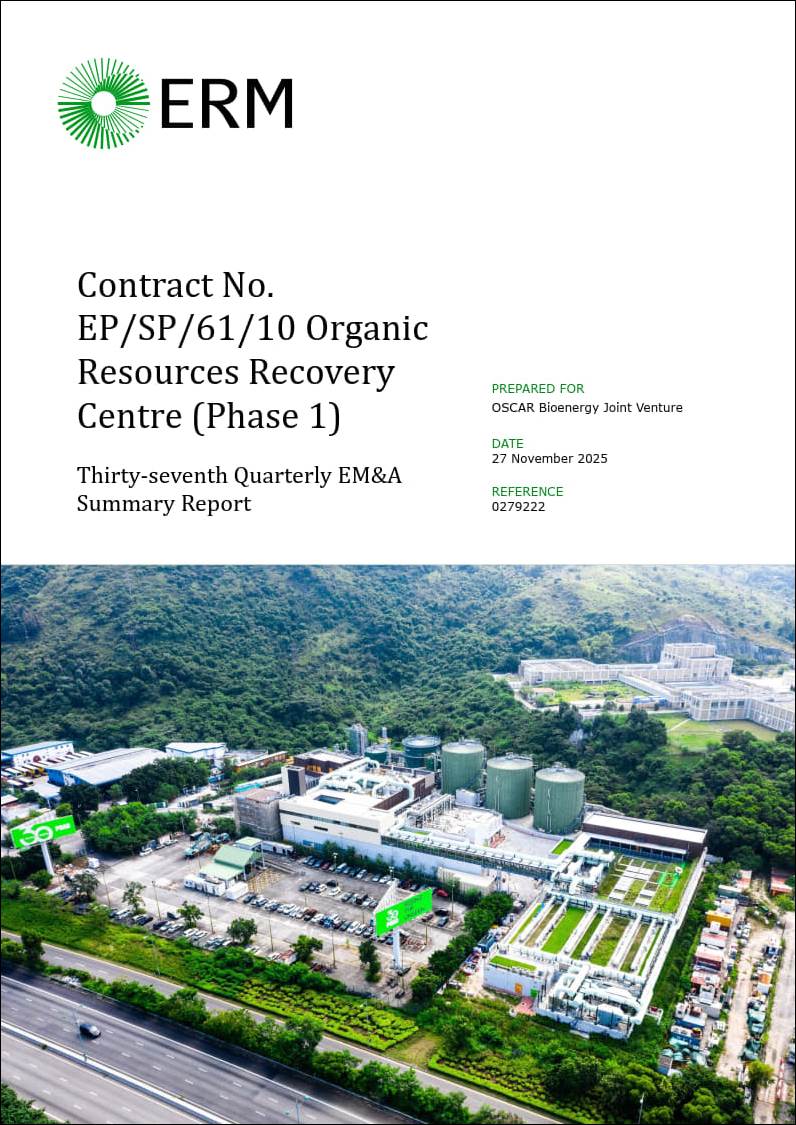
The construction works of No.
EP/SP/61/10 Organic Resources Recovery Centre Phase 1 (the
Project) commenced on 21 May
2015. This is the 37th Quarterly Environmental Monitoring and Audit
(EM&A) report presenting the EM&A works carried out during the period
from 1 June 2024 to 31 August 2024 in accordance with the EM&A Manual.
Environmental Monitoring and Audit
Progress
Air Quality
Monitoring
Non-compliance of emission limits of
NOx and SO2, from CHP1; NOx from CHP2; NOx
from CHP3; and NOx, SO2, and NH3, from the ASP
were recorded during June 2024.
Non-compliance of emission limits of
NOx and HCl from CHP1; NOx from CHP2; NOx from
CHP3; NOx, SO2, and NH3 from the ASP; and
Dust, CO, VOCs, and HF from the Standby Gas Flaring Unit were recorded during
July 2024.
Non-compliance of emission limits of Total
Odour from CAPCS; NOx and SO2 from CHP1; NOx
from CHP2; NOx, SO2, NH3, and HCl from the
ASP; and VOCs and HF from the Standby Gas Flaring Unit were recorded during
August 2024.
Exceedances occurred due to sensor issues,
system instability, emergency condition and unstable operation.
Environmental Exceedance/
Non-conformance/ Compliant/ Summons and Prosecution
Exceedances for the air emission limits for the CAPCS, CHP, and ASP
stacks were recorded during the reporting period.
No complaint was received during the
reporting period.
1. PROJECT INFORMATION
1.1
Background
The Organic Resources Recovery
Centre (ORRC) Phase I development (hereinafter referred to as “the Project”) is
to design, construct and operate a biological treatment facility with a
capacity of about 200 tonnes per day and convert source-separated organic waste
from commercial and industrial sectors (mostly food waste) into compost and
biogas.
ERM-Hong Kong, Ltd (ERM)
has been appointed by OSCAR as the Environmental Team (ET) for the construction
phase EM&A programme and the Monitoring Team (MT) for the operation phase
EM&A programme for the implementation of the EM&A programme in accordance with the
requirements of the EP and the approved EM&A Manual.
1.2 General Site Description
The Project Site is located at Siu Ho Wan in
North Lantau with an area of about 2 hectares. The facility received an average
of 165.26 to 181.95 tonnes and treated an average of 127.83 to 137.07 tonnes of
source separated organic waste per day during the reporting period.
1.2.1 MAJOR ACTIVITIES UNDERTAKEN
A summary of the major activities undertaken in
the reporting period is shown in Table 1.1.
Table 1.1 Summary of Activities Undertaken in the
Reporting Period
|
Activities Undertaken in the Reporting Period |
|
· Operation of the
Project, including organic waste reception, and operation of the
pre-treatment facilities, anaerobic digesters, composting facilities, air
pollution control systems, on-line emission monitoring system for the
Centralised Air Pollution Control Unit (CAPCS), Co-generation Units (CHP)s
and Ammonia Stripping Plant (ASP), and the wastewater treatment plant; · CHP fine-tuning ongoing
(will continue into next month); · PT Line 1 overhaul
ongoing (will continue into next month); · ASP overhaul; · Operation of the Project,
including organic waste reception, and operation of the pre-treatment
facilities, anaerobic digesters, composting facilities, air pollution control
systems, on-line emission monitoring system for the Centralised Air Pollution
Control Unit (CAPCS), Co-generation Units (CHP)s and Ammonia Stripping Plant
(ASP), and the wastewater treatment plant; · CHP fine-tuning
(began in June 2024, will continue into next month);
· Overhaul of PT
Line 1 completed · Operation of the
Project, including organic waste reception, and operation of the
pre-treatment facilities, anaerobic digesters, composting facilities, air
pollution control systems, on-line emission monitoring system for the
Centralised Air Pollution Control Unit (CAPCS), Co-generation Units (CHP)s
and Ammonia Stripping Plant (ASP), and the wastewater treatment plant; · Ongoing repair
works for front roller shutter for Receiving Bay 2 & 3; and · ASP column 1
Cleaning |
2.
Environmental
Monitoring and Audit Requirements AND RESULTS
2.1
Environmental Monitoring
2.1.1 AIR QUALITY
The concentrations of concerned air
pollutants emitted from the stacks of the CAPCS, CHP, and ASP during the
reporting period are monitored on-line by the continuous environmental
monitoring system (CEMS). The number of exceedances of the concerned air
emissions monitored for the CAPCS, CHP and ASP during this reporting period are
presented in Tables 2.1 to 2.6.
It should be noted that measurements recorded
under abnormal operating conditions, e.g., start up and stopping of stacks and
unstable operation, as well as test runs and interference of sensor, are
disregarded.
Table 2.1 Hourly Average of Parameters Recorded for
CAPCS
|
Parameter |
Range of Hourly Average Conc. (mg/Nm3) |
Emission Limit (mg/Nm3) |
Exceedance Identified |
Remarks |
|
VOCs (including methane) (a) |
0 – 579 |
680 |
Nil |
Nil |
|
Dust (or TSP) |
0 – 0 |
6 |
Nil |
Nil |
|
Odour (including
NH3 & H2S) (b) |
0 – 964.56 |
220 |
Identified (c) |
Sensor issues |
|
Notes: (a) The VOCs emission limit includes methane as biogas is adopted, as fuel
in the combustion process. (b) The odour unit is OU/Nm3. (c) Dates with Odour exceedances (number
of exceedances on that day) were identified on 26(13), 27(6), 28(12), 29(21),
30(9), and 31(6) August 2024. |
||||
Table 2.2 Hourly Average of Parameters Recorded for
CHP 1
|
Parameter |
Range
of Hourly Average Conc. (mg/Nm3) (a) |
Max.
Emission Limit (mg/Nm3) |
Exceedance Identified |
Remarks |
|
Dust (or TSP) |
0 - 7 |
15 |
Nil |
Nil |
|
Carbon Monoxide |
0 - 136 |
650 |
Nil |
Nil |
|
NOx |
0 – 666 |
300 |
Identified (c) |
System unstable
(e.g., low efficiency) |
|
SO2 |
0 – 74 |
50 |
Identified (d) |
System unstable (e.g., low efficiency) |
|
VOCs (including methane) (b) |
0 – 882 |
1,500 |
Nil |
Nil |
|
HCl |
0 - 12 |
10 |
Identified (e) |
System unstable (e.g., low efficiency) |
|
HF |
0 - 1 |
1 |
Nil |
Nil |
|
Notes: (a)
All values refer to an oxygen content in the exhaust
gas of 6% and
dry basis. (b)
The
VOCs emission limit includes methane as biogas is adopted as fuel in the
combustion process. (c)
Dates with NOx exceedances (number of exceedances on
that day) were identified on 1(24), 2(24), 3(13), 4(14), 5(20), 6(14), 7(18),
8(24), 9(24), 10(24), 11(24), 12(24), 13(24), 14(12), 15(12), 16(24), 17(2),
18(8), 19(21), 20(24), 21(24), 22(24), 23(24), 24(15), 25(24), 26(24),
27(23), 28(23), 29(24), and 30(23) June 2024; 1(24), 2(24), 3(24), 4(24),
5(23), 6(24), 7(24), 8(9), 9(8), 10(24), 11(24), 12(18), 13(24), 14(24),
15(21), 16(18), 17(13), 18(24), 19(21), 20(18), 21(14), 22(9), 23(21),
24(18), 25(21), 26(14), 27(24), 28(24), 29(24), 30(24), and 31(23) July 2024;
and 1(21), 2(23), 3(24), 4(24), 5(23), 6(24), 7(24), 8(24), 9(24), 10(24),
11(18), 12(24), 13(24), 14(24), 15(24), 16(24), 17(24), 18(24), 19(24),
20(24), 21(21), 22(24), 23(24), 24(24), 25(24), 26(24), 27(24), 28(24),
29(24), 30(24), and 31(23) August 2024. (d)
Dates with
SO2 exceedances (number of exceedances on that day) was identified on 28(11)
June 2024
and 8(6), 9(21), 10(24), 11(10), 12(13), 13(14), 14(20),
16(11), 17(8), 18(13), 19(15), 28(6), 29(10), and 30(4) August 2024. (e)
Date with HCl exceedance (number of exceedances on
that day) was identified on 23(1) July 2024. |
||||
Table 2.3 Hourly Average of Parameters Recorded for
CHP 2
|
Parameter |
Range of Hourly Average Conc. (mg/Nm3)
(a) |
Max. Emission Limit (mg/Nm3) |
Exceedance Identified |
Remarks |
|
Dust (or TSP) |
0 – 8 |
15 |
Nil |
Nil |
|
Carbon Monoxide |
0 – 490 |
650 |
Nil |
Nil |
|
NOx |
0 – 461 |
300 |
Identified (c) |
System unstable (e.g., low efficiency) |
|
SO2 |
0 – 48 |
50 |
Nil |
Nil |
|
VOCs (including methane)
(b) |
0 – 569 |
1,500 |
Nil |
Nil |
|
HCl |
0 – 10 |
10 |
Nil |
Nil |
|
HF |
0 – 1 |
1 |
Nil |
Nil |
|
Notes: (a)
All values refer to an oxygen content in the exhaust
gas of 6% and
dry basis. (b)
The
VOCs emission limit includes methane as biogas is adopted as fuel in the
combustion process. (c)
Dates with NOx exceedances (number of
exceedances on the day) were identified on 1(9), 2(3), 3(10), 4(11), 5(10),
6(10), 7(9), 8(15), 9(8), 10(5), 11(4), 12(3), 13(11), 14(1), 15(4), 16(2),
17(1), 18(8), 19(1), 20(5), 21(3), 22(6), 23(7), 24(9), 25(12), 26(6), and
27(12) June 2024; 9(7), 10(24), 11(9), 12(7), 13(24), 14(24), 15(24), 16(18),
17(2), 18(1), 19(1), 20(2), 22(1), 23(3), 24(1), 28(1), 29(1), and 31(1) July
2024; and 1(8), 2(21), 3(18), 4(23), 5(15), 6(9), 8(17), 9(24), 10(18),
11(2), 12(7), 13(6), 14(10), 15(1), 20(2), 21(5), 22(13), 23(12), 24(2),
25(1), 27(2), and 28(4) August 2024. |
||||
Table 2.4 Hourly Average of Parameters Recorded for
CHP 3
|
Parameter |
Range of Hourly Average Conc. (mg/Nm3)
(a) |
Max. Emission Limit (mg/Nm3) |
Exceedances Identified |
Remarks |
|
Dust (or TSP) |
0 – 13 |
15 |
Nil |
Nil |
|
Carbon Monoxide |
0 – 245 |
650 |
Nil |
Nil |
|
NOx |
0 – 556 |
300 |
Identified (c) |
System unstable (e.g., low efficiency) |
|
SO2 |
0 – 50 |
50 |
Nil |
Nil |
|
VOCs (including methane) (b) |
0 – 604 |
1,500 |
Nil |
Nil |
|
HCl |
0 – 1 |
10 |
Nil |
Nil |
|
HF |
0 – 1 |
1 |
Nil |
Nil |
|
Notes: (a) All values refer to an oxygen content in the exhaust
gas of 6% and dry basis. (b) The VOCs emission limit includes methane as biogas is
adopted as fuel in the combustion process. (c)
Dates with NOx exceedances (number of
exceedances on the day) were identified on 20(1), 21(4), 22(14),
24(3), 25(2), 27(4), 28(14), 29(16), and 30(24) June 2024; and 1(24), 2(24),
3(24), 4(24), 5(24), 6(22), 7(18), 8(7), 9(24), 10(24), 11(23), 12(23),
13(24), 14(24), 15(24), 16(24), and 17(9) July 2024. |
||||
Table
2.5
Hourly Average
of Parameters Recorded for ASP
|
Parameter |
Range of Hourly
Average Conc. (mg/Nm3) (a) |
Max. Emission Limit (mg/Nm3) |
Exceedances Identified |
Remarks |
|
Dust (or TSP) |
0 – 5 |
5 |
Nil |
Nil |
|
Carbon Monoxide |
0 – 96 |
100 |
Nil |
Nil |
|
NOx |
0 – 970 |
200 |
Identified (c) |
System unstable (e.g., low efficiency, unstable
column temperature) |
|
SO2 |
0 – 210 |
50 |
Identified (d) |
System unstable (e.g., low efficiency, unstable
column temperature) |
|
VOCs (including methane) (b) |
0 – 20 |
20 |
Nil |
Nil |
|
NH3 |
0 – 318 |
35 |
Identified (e) |
System unstable (e.g., low efficiency,
unstable column temperature) |
|
HCl |
0 – 26 |
10 |
Identified (f) |
System unstable (e.g., low efficiency,
unstable column temperature) |
|
HF |
0 – 1 |
1 |
Nil |
Nil |
|
Notes: (a)
All values refer to an oxygen content in the exhaust
gas of 11% and dry basis. (b)
The VOCs emission limit include methane
as biogas is adopted as fuel in the combustion process. (c)
Dates with NOx exceedances (number of
exceedances on the day) were identified on 1(5), 2(7), 3(8), 4(4),
5(5), 6(18), 7(12), 8(13), 9(22), 10(8), 11(22), 12(12), 13(3), 14(9),
15(15), 16(14), 17(7), 19(5), 21(3), 22(2), 23(1), 24(3), 25(1), 26(11),
27(3), 28(12), 29(7), and 30(6) June 2024; 1(20), 2(17),
3(11), 4(11), 5(11), 6(15), 7(16), 8(18), 9(24), 10(18), 11(21), 12(22),
13(17), 14(24), 15(22), 16(18), 17(6), 18(6), 19(20), 20(17), 21(9), 22(10),
24(13), 25(12), 26(12), 27(14), 28(4), 29(5), 30(7), and 31(7) July 2024; and
1(23), 2(19), 3(5), 4(4), 6(8), 7(21), 8(17), 9(3), 10(12), 11(1), 12(8),
13(13), 14(10), 15(5), 16(9), 17(10), 18(7), 19(11), 20(11), 21(5), 22(8),
23(14), 24(13), 25(1), 26(2), 27(15), 28(15), 29(11), 30(23), and 31(23)
August 2024. (d)
Dates with SO2 exceedances (number of
exceedances on the day) were identified on 1(1), 3(2), 4(1), 5(1), 7(1),
8(3), 15(9), 23(1), 28(14), 29(13), and 30(16) June 2024; 1(3), 14(1), 15(9),
17(2), 19(2), 28(7), 29(1), 30(3), and 31(12) July 2024; and 6(9), 7(24),
8(18), 9(3), 10(24), 11(24), 12(21), 13(19), 14(24), 15(12), 16(18), 17(23),
18(24), 19(20), 20(21), 21(15), 22(23), 23(8), 28(14), 29(24), and 30(21)
August 2024. (e)
Dates with NH3 exceedances (number of
exceedances on the day) were identified on 1(11), 3(3), 4(12), 5(6), 6(1),
7(2), 8(3), 10(7), 11(2), 14(3), 15(2), 18(14), 19(1), 20(1), 23(4), 24(5),
25(22), 26(11), 27(12), 28(8), 29(4), and 30(8) June 2024; 1(10), 2(15),
3(10), 4(7), 5(4), 6(6), 7(1), 11(1), 17(9), 18(7), 20(2), 23(1), 24(5),
25(5), 26(8), 27(3), 29(1), and 30(3) July 2024; and 1(1), 2(5), 3(2), 4(5),
5(22), 6(20), 7(16), 8(18), 10(2), 11(8), 12(13), 13(6), 14(4), 15(8), 16(7),
17(9), 18(10), 19(9), 20(8), 21(7), 22(2), 23(7), 24(6), 25(1), 26(2),
27(15), 28(7), 29(16), 30(1), and 31(1) August 2024. (f)
Dates with HCl exceedances (number of exceedances on
the day) were identified on 6(2), 7(1), 8(1), 11(1), and 13(1) August 2024. |
||||
Table 2.6 Hourly Average of Parameters Recorded for
the Standby Flaring Gas Unit
|
Parameter |
Range of Hourly
Average Conc. (mg/Nm3) (a) |
Max. Emission Limit (mg/Nm3) |
Exceedances Identified |
Remarks |
|
Dust (or TSP) |
0 – 8 |
5 |
Identified (c) |
Emergency condition required the use of flare |
|
Carbon Monoxide |
0 – 821 |
100 |
Identified (d) |
Emergency condition required the use of flare |
|
NOx |
0 – 73 |
200 |
Nil |
Nil |
|
SO2 |
0 – 5 |
50 |
Nil |
Nil |
|
VOCs (including methane) (b) |
0 – 1,300 |
20 |
Identified (e) |
Emergency condition required the use of flare,
unstable operation (low temperature) |
|
HCl |
0 – 4 |
10 |
Nil |
Nil |
|
HF |
0 – 5 |
1 |
Identified (f) |
Emergency condition required the use of flare,
unstable operation (low temperature) |
|
Notes: (a)
All values refer to an oxygen content in the exhaust
gas of 11% and dry basis. (b)
The VOCs emission limit include methane as biogas is
adopted as fuel in the combustion process. (c)
Date with Dust exceedance (number of exceedance on that day) was identified on 11(1) July 2024. (d)
Date with CO exceedance (number of exceedance on that day) was identified on 5(1) July 2024. (e)
Dates with
VOCs exceedances (number of exceedances on that day) was identified on 5(1)
July 2024 and 23(1) August 2024. (f)
Dates with HF exceedances (number of exceedances on
that day) were identified on 5(2), 6(4), 7(3), 8(5), 11(1), 22(1), 23(1), and
26(2) July 2024 and 23(1) August 2024. |
||||
2.1.2 ODOUR
Odour patrol was conducted by the
independent odour patrol team of ALS Technichem (HK)
Pty Ltd on 5 July 2024, 8 July 2024, 9 July 2024; and 9 August 2024, 15 August
2024 respectively.
No complaint was received during the
reporting period.
2.2 SITE AUDIT
Environmental mitigation measures (related to
air quality, water quality, waste, land contamination, hazard-to-life, and
landscape and visual) to be implemented during the operation phase of the
Project are recommended in the approved EIA Report and EM&A Manual.
Monthly site audits for June 2024 to August 2024 have been carried out to
check the implementation of these mitigation measures. Follow-up actions
resulting from the site audits were generally taken as reported by the
Contractor. The Contractor has implemented environmental mitigation
measures recommended in the approved EIA Report and EM&A Manual.
2.3 Landscape and Visual
The monthly inspections of the landscape and
visual mitigation measures for the operation phase of the Project were
performed on 28 June 2024, 25 July 2024 and 19 August 2024, and no
non-compliance in relation to the landscape and visual mitigation measures were
identified.
2.4
WASTE MANAGEMENT
Wastes generated from the operation of the
Project include chemical waste, wastes generated from pre-treatment process and
general refuse. The quantities of different types of waste generated from
the operation of the Project in the reporting period are summarised in Table
2.7.
Table 2.7
Quantities of Waste Generated from the Operation of the Project
|
Month
/ Year |
Chemical
Waste |
Waste
Generated from |
General
Refuse |
||
|
|
Disposal
of at CWTC |
Disposed
of at Landfill (a) |
Recycled
(b) |
Disposed
of at Landfill (a) (e) |
Recycled
(c) |
|
June 2024 |
1,200 L (d) |
1,199.51 tonnes |
0 tonnes |
4.080 tonnes (e) |
0.052 tonnes |
|
July 2024 |
18.496 L (d) |
1,391.16 tonnes |
0 tonnes |
2.995 tonnes (e) |
0.085 tonnes |
|
August 2024 |
1,200 L (d) |
1,160.32 tonnes |
0 tonnes |
3.110 tonnes (e) |
0.038 tonnes |
|
Notes: (a) Waste generated from pre-treatment process and general refuse other
than chemical waste and recyclables were disposed of at NENT landfill by
sub-contractors. (b) Among waste generated from pre-treatment process, no metals, papers/
cardboard packing or plastics were sent to recyclers for recycling during the
reporting period. (c) Among general refuse, 0.003 tonnes of metals, 0.125 tonnes of papers/
cardboard packing and 0.047 tonnes of plastics were sent to recyclers for
recycling during the reporting period. (d) 1,200L of chemical waste (spent lube oil) was disposed of at CWTC in
June 2024; 16,000L of chemical waste (unwanted flocculant agent) was disposed
of at CWTC in July 2024. 4,560kg of chemical waste (waste lead-acid battery)
was also disposed of at CWTC in July 2024; for unit consistency this figure
has been converted to 2,496L, assuming a density of 1.827 kg/L; and 1,200L of
chemical waste (spent lube oil) was disposed of at CWTC in August 2024. (e) It was assumed that four 240-litre bins filled with 80% of general
refuse were collected at each collection. The general refuse density was
assumed to be around 0.15 kg/L. |
|||||